Yellowstone National Park spans 3,472 square miles of volcanic wilderness across Wyoming, Montana, and Idaho. It contains half the world's active hydrothermal features and the largest concentration of mammals in the lower 48 states.
Yellowstone sits directly above a massive volcanic hot spot. The park covers 2,221,766 acres of lodgepole pine forests, alpine rivers, and deep canyons across three states. Wyoming contains 96 percent of the landmass, Montana holds 3 percent, and Idaho claims the final 1 percent. Half of the earth's hydrothermal features boil and erupt within these borders. Visitors walk on wooden boardwalks inches above pools of boiling, acid-rich water. Steam vents hiss from the ground. Bison herds frequently block the 310 miles of paved roads, stopping traffic for hours.
The landscape shifts drastically depending on elevation. Reese Creek sits at the lowest point of 5,282 feet, while Eagle Peak rises to 11,358 feet. This extreme geography creates unpredictable weather patterns. Snow routinely falls in July. High altitudes leave visitors short of breath on flat trails, requiring double the normal water intake. Wheelchair users navigate the park easily. Extensive boardwalks cover the major attractions like Old Faithful and Grand Prismatic. Paved, flat paths lead to viewpoints like Artist Point and Lookout Point. Medical clinics in Mammoth, Lake, and Old Faithful rent wheelchairs for $10 per day.
Most people arrive between July and August when all roads open. April and November bring "mud season," forcing the closure of facilities and most roads as the park transitions between extremes. Winter restricts access entirely to guided snowmobiles and snowcoaches. Only the road connecting the North Entrance in Gardiner to the Northeast Entrance remains clear for regular vehicles year-round. The sheer scale of the park requires significant driving. The Grand Loop Road forms a figure-eight through the center of the reserve, connecting the major basins and valleys.
Entry costs $35 per private vehicle for a seven-day pass. Starting January 1, 2026, non-U.S. residents over the age of 16 must pay an additional $100 surcharge. Cell service drops to zero outside of Mammoth, Old Faithful, and Canyon Village. Download the official NPS app and save the map for offline use before crossing the boundary.
Native American tribes hunted, gathered, and lived in the Yellowstone region for over 11,000 years before European-American settlement. The Minnetaree tribe called the area's primary waterway "Mi tse a-da-zi," meaning Rock Yellow River. Obsidian from the park's cliffs provided material for cutting tools and weapons. Archaeologists have found Yellowstone obsidian as far east as the Ohio Valley, indicating extensive ancient trade networks. Tribes like the Shoshone, Bannock, and Nez Perce utilized the thermal springs for ceremonial and medicinal purposes.
President Ulysses S. Grant signed the Yellowstone National Park Protection Act on March 1, 1872. This legislation created the world's first national park. Early management struggled with poachers and vandals destroying the geothermal features. Congress refused to fund the park's administration, leaving early superintendents without pay or resources. The U.S. government deployed the Army to Mammoth Hot Springs in 1886 to protect the land. Soldiers built Fort Yellowstone and patrolled the backcountry on skis during winter. They expelled poachers, stopped the slaughter of the remaining bison, and established the conservation policies still used today.
The National Park Service took over management in 1916. Automobile travel soon replaced stagecoaches, requiring the construction of the 310-mile Grand Loop Road. Early visitors arrived by train to gateway towns before boarding horse-drawn wagons. Today, most fly into Bozeman Yellowstone International Airport, located 90 miles from the North Entrance. Tourism surged throughout the 20th century, bringing new challenges to wildlife management. Park rangers routinely fed bears at garbage dumps to entertain tourists until the 1970s. Modern policies strictly prohibit approaching animals. Visitors must stay 100 yards from bears and wolves, and 25 yards from bison.
Wildfire reshaped the landscape in 1988. Flames consumed nearly 800,000 acres, accounting for 36 percent of the park. The event changed national fire management policy, shifting focus from absolute suppression to allowing natural fires to burn when they do not threaten human structures. The lodgepole pines regenerated quickly, as their serotinous cones require intense heat to release seeds. Over 4.7 million people entered the gates in 2025. Parking lots at Grand Prismatic Spring and Old Faithful fill completely by 9:00 AM during the summer months. Arrive before sunrise or after 6:00 PM to secure a spot and avoid the heaviest crowds.
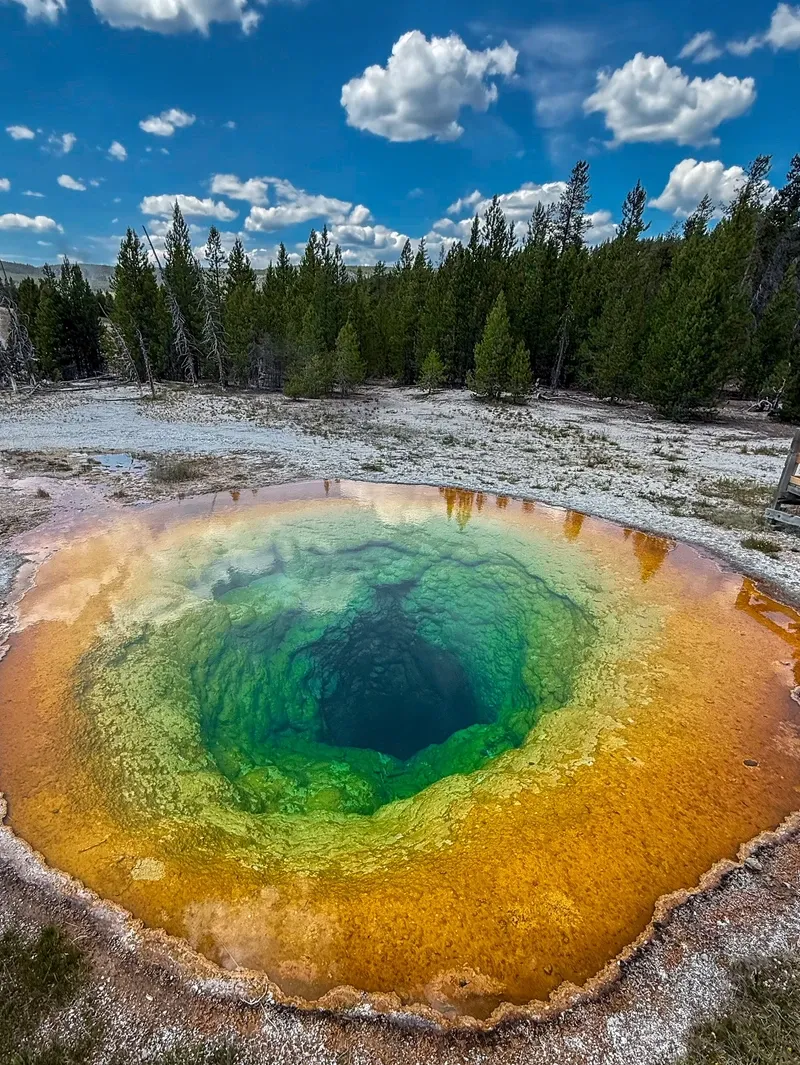
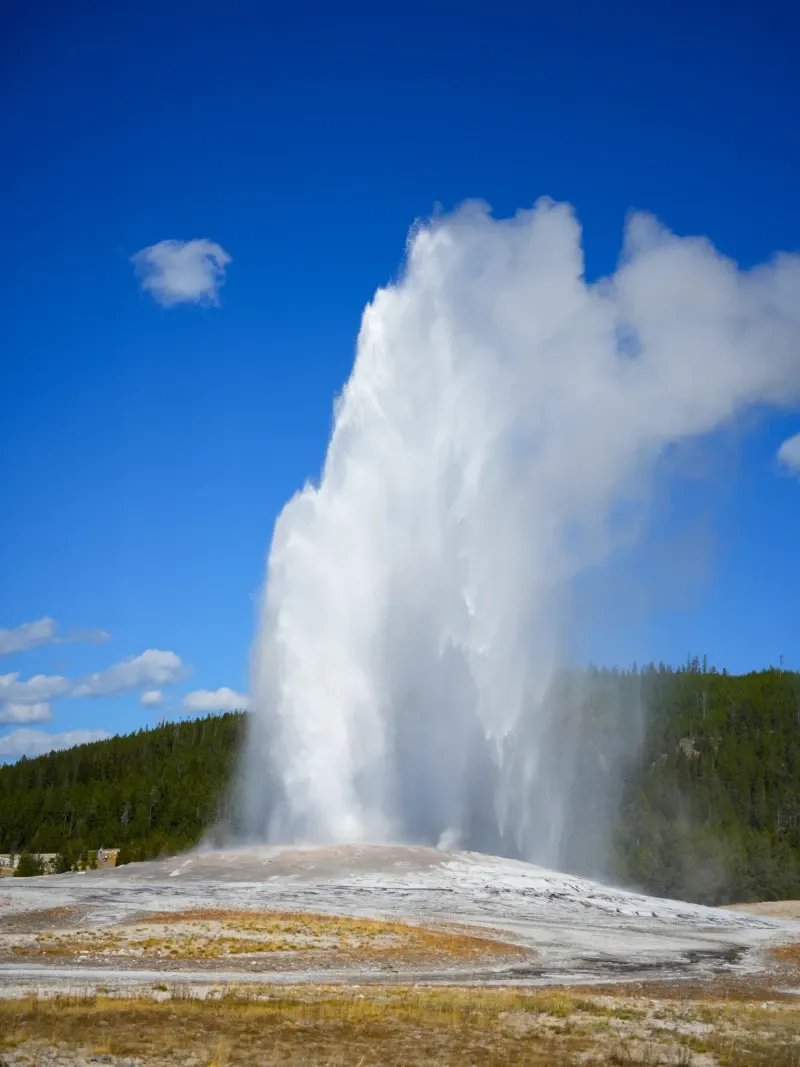
A supervolcano powers the 10,000 hydrothermal features scattered across the Yellowstone caldera. Magma sits just three to eight miles beneath the surface, heating groundwater until it flashes into steam. Old Faithful erupts every 60 to 110 minutes, shooting water up to 180 feet in the air. The eruption lasts between one and five minutes, expelling up to 8,400 gallons of boiling water. Grand Prismatic Spring spans 370 feet across and drops 121 feet deep. Thermophilic bacteria thrive in its scalding waters, creating distinct rings of orange, yellow, and green around a deep blue center. The colors change intensity based on the season and water temperature.
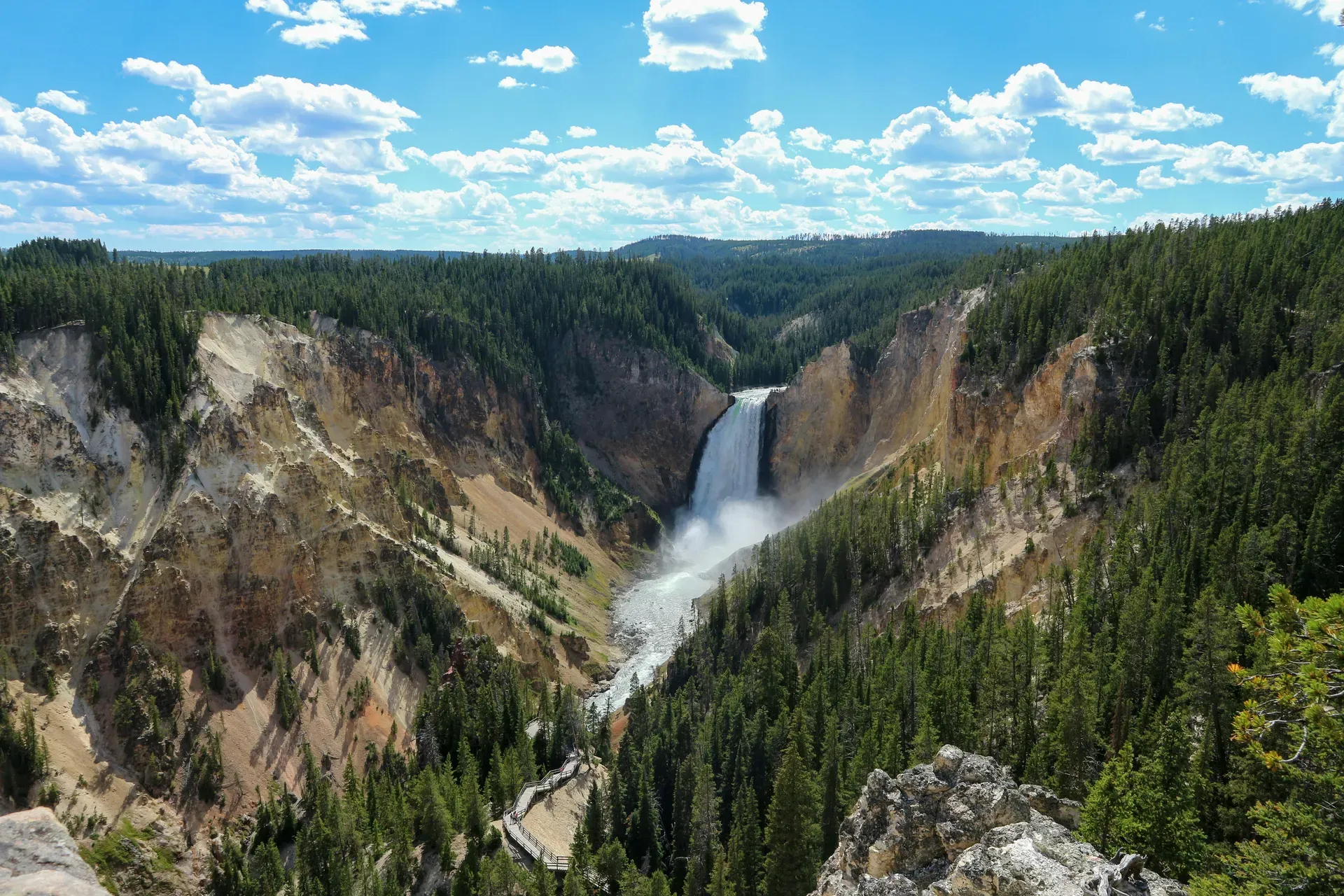
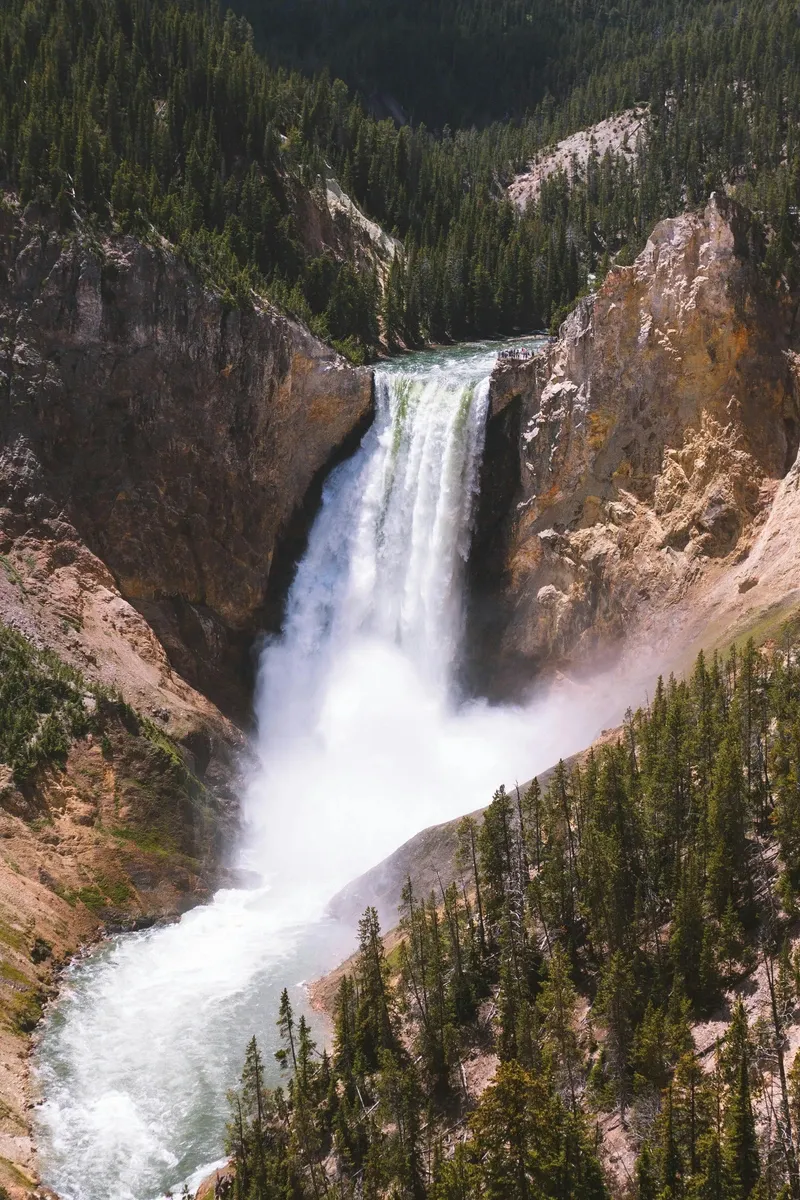
The Grand Canyon of the Yellowstone cuts a 20-mile gash through the landscape. Rhyolite rock walls drop 1,200 feet to the river below. Hydrothermal alteration baked the canyon walls into shades of yellow and pink. At the canyon's head, the Lower Falls plunge 308 feet, throwing mist onto the surrounding pine trees. This drop measures nearly twice the height of Niagara Falls. Visitors can feel the vibration of the water from the brink trail. A steep, paved path leads down 600 feet to the base of the falls at Uncle Tom's Trail.
Mammoth Hot Springs presents a different geological process. Acidic groundwater dissolves limestone beneath the surface. The water deposits calcium carbonate above ground, building massive white and brown travertine terraces. These formations grow and shift daily, resembling inside-out caves. Two tons of limestone flow onto the surface every day. The terraces expand rapidly, sometimes swallowing trees and boardwalks in a matter of months.
Yellowstone Lake dominates the southeastern quadrant of the park. It covers 131.7 square miles and features 141 miles of shoreline. The water remains dangerously cold year-round, averaging 41°F. Survival time in the lake measures in minutes. Underwater geysers and hot springs boil at the bottom of the lake, creating a bizarre environment where extreme heat meets freezing water. Stepping off the constructed boardwalks in any of these thermal basins risks fatal burns. The crust looks solid but often hides boiling acidic water just inches below.
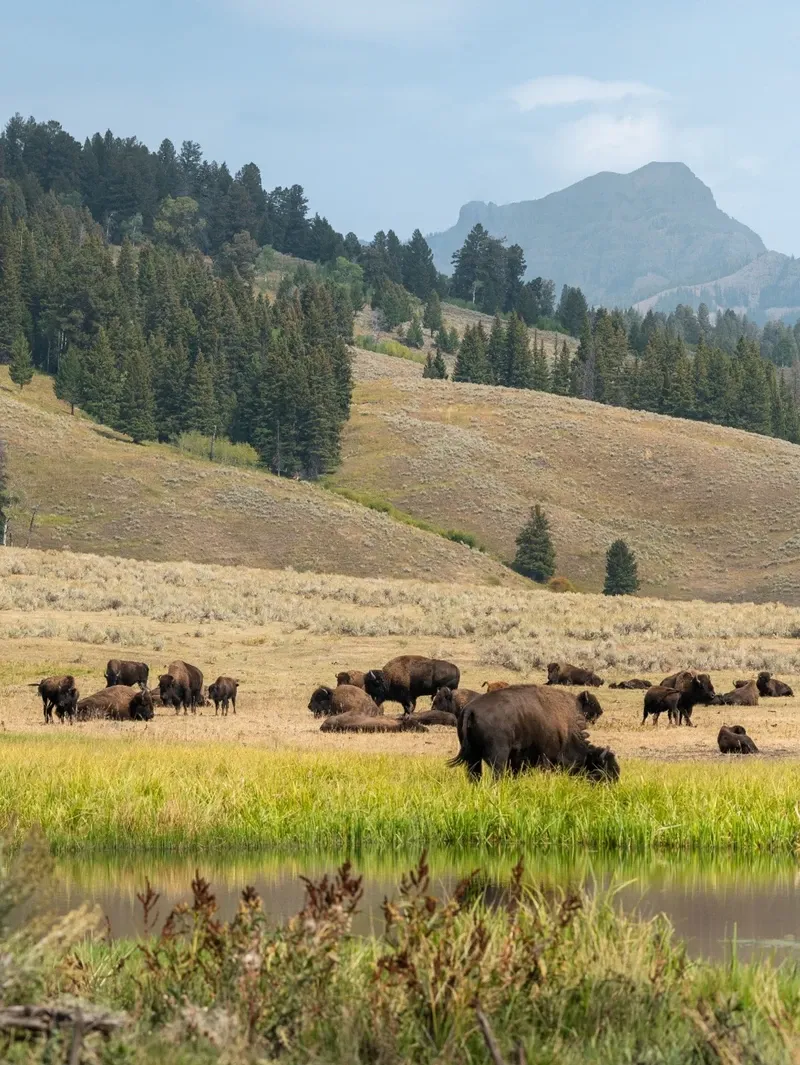
Yellowstone operates as a living laboratory for wildlife conservation. It is the only place in the United States where bison have lived continuously since prehistoric times. The current herd fluctuates between 4,000 and 5,000 animals. Lamar Valley, located in the park's northeast corner, provides the primary stage for predator-prey dynamics. Biologists reintroduced gray wolves here in 1995 after a 70-year absence. The valley now draws thousands of researchers and wildlife watchers who line the roads at dawn with spotting scopes. The reintroduction stabilized the elk population and allowed willow and aspen trees to recover along the riverbanks.
The park's creation sparked a global conservation movement. Over 100 nations have modeled their own protected areas after the Yellowstone experiment. The United Nations designated it a Biosphere Reserve in 1976 and a World Heritage site in 1978. This international status recognizes the unbroken ecosystem that extends well beyond the park's official boundaries. The Greater Yellowstone Ecosystem encompasses 22 million acres, representing one of the largest nearly intact temperate-zone ecosystems on Earth. The park connects directly to other major geographical features. Grand Teton National Park sits just 10 minutes south of the Yellowstone boundary.
Human interaction with the landscape requires constant regulation. Bison injure more people here than any other animal. They weigh up to 2,000 pounds and run 35 miles per hour. Tourists frequently ignore the 25-yard distance rule, resulting in severe gorings. The high altitude also affects visitor behavior. At 8,000 feet, oxygen levels drop significantly. Flat boardwalks cause unexpected fatigue and shortness of breath.
The cultural shift in how humans view the park continues to evolve. Early administrators treated the land as a menagerie, building zoos and fencing in animals. Current management prioritizes natural processes. Dead trees remain where they fall to provide nutrients for the soil. Wildfires burn unhindered unless they threaten human life or historical structures. Carry bear spray on every trail and know how to remove the safety clip. You are entering a wild environment where human safety is not guaranteed.
Water in the park's hot springs routinely exceeds the boiling point of 199°F at this altitude.
The park's highest peak, Eagle Peak, reaches 11,358 feet above sea level.
Thermophilic bacteria cause the vivid rainbow colors visible in Grand Prismatic Spring.
Bison cause more human injuries in Yellowstone than bears, wolves, or any other animal.
Wi-Fi speeds at the park's lodges average just 1.5 megabytes per second.
Snow plows only maintain the road between the North and Northeast entrances during winter.
The National Park Service strictly prohibits all drone flights to protect wildlife.
No. Wrangell–St. Elias in Alaska is the largest at 13 million acres. Yellowstone ranks second in the contiguous U.S. behind Death Valley.
No. Entering the thermal features is illegal and often fatal. The only designated swimming area exists at Firehole Canyon.
No vehicle reservations are required as of 2024-2026. You must purchase an entrance pass at the gate or online.
Service is extremely limited. You will only find a signal in developed areas like Mammoth, Old Faithful, and Canyon Village.
No. Pets must remain within 100 feet of roads or parking lots. They must be kept on a leash at all times.
It is named after the Yellowstone River. The Minnetaree tribe originally called it "Mi tse a-da-zi," which translates to Rock Yellow River.
No. The use of drones is prohibited in all U.S. National Parks. Rangers will confiscate equipment and issue heavy fines.
July and August offer full road access and warm weather. September provides excellent wildlife viewing during the elk rut with fewer crowds.
Most visitors spend three to four days exploring the park. This allows enough time to drive the Grand Loop Road and see the major thermal basins.
You risk falling through thin mineral crusts into boiling water. Thermal burns are a leading cause of severe injury and death in the park.
Browse verified tours with free cancellation and instant confirmation.
Find Tours